
Reports
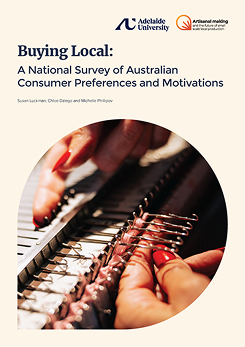
Buying Local: A National Survey of Australian Consumer Preferences and Motivations.
This report presents the results of a nationally representative survey of Australian consumers exploring their preferences and motivations for buying locally produced goods.
Consumers were asked whether they sought to buy locally produced fruit and vegetables, meat including smallgoods, wine and/or beer, spirits, clothing, furniture, other household goods (e.g. manchester, tableware), decorative items for the home, and personal accessories (jewellery, bags, etc.); their reasons for doing so; and, if they were willing and able to pay for locally made goods, how much more they were willing to pay.
For those who sought to buy local, the overall top three reasons were: ‘To support local economy and jobs’ (clearly out in front), then ‘Better quality’ closely followed by ‘I prefer to support small business’. This was consistent across all product categories.
Our results largely support what is known in the international literature, that is, that those who buy local are predominantly women, with high levels of education though, counter-intuitively, not always high levels of income.
One trend reported in the literature that was born out less in our study was the tendency for older people (45+ years) to be more likely to buy local. Instead, we found that those in the 45–64 age bracket were less likely to be willing to pay more.
While the results show that a large part of the Australian consumer market is not willing to pay more for locally made goods (of any type), when people are willing to pay more, they are significantly more likely to do so for locally sourced or produced clothing, fruit and vegetables, furniture, and meat including smallgoods. They were least likely to be willing to pay more for locally produced spirits and decorative items for the home.
Of those who were willing to pay more for local goods, women were significantly more likely to do so than men. Young people and women were more likely to be concerned about environmental and labour conditions, especially for clothing and personal accessories. Men were more motivated by quality and perceptions of safety and trust, while older people sought to support small business and wanted to know where and how products were produced.





This research was supported by the Australian Government through the Australian Research Council’s Discovery Projects funding scheme (project DP220100110). The views expressed herein are those of the authors and are not necessarily those of the Australian Government.

We respectfully acknowledge the Kaurna, Boandik and Barngarla First Nations Peoples and their Elders past and present, who are the First Nations’ Traditional Owners of the lands that are home to our campuses located in Adelaide, Magill, Mawson Lakes, Waite, Roseworthy, Mount Gambier and Whyalla.